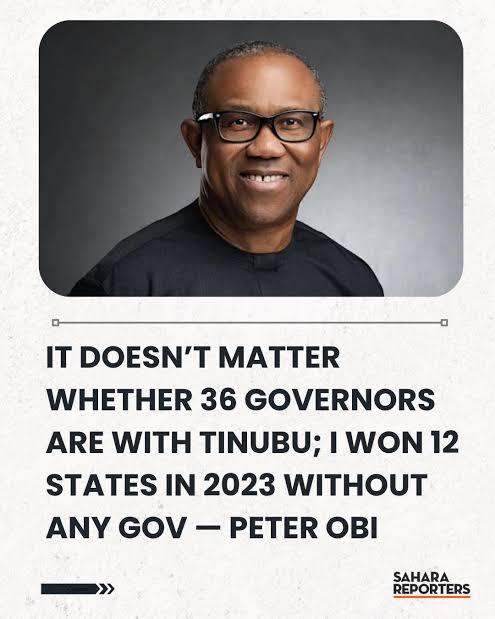


Former Labour Party presidential candidate Peter Obi has stated that the support of state governors does not necessarily guarantee electoral victory, insisting that his performance in the 2023 presidential election proved that voters remain the ultimate deciding factor in democratic contests.
Speaking on the evolving political landscape ahead of the 2027 general elections, Obi argued that despite lacking the backing of serving governors during the 2023 election cycle, he was still able to secure victories in multiple states across the country.
According to him, the outcome demonstrated that political influence at the grassroots level can be more important than endorsements from powerful political figures.
Obi's remarks come amid growing political realignments and speculation over possible alliances ahead of the next general election.
Responding to discussions about support for President Bola Tinubu among elected governors, Obi reportedly maintained that such endorsements should not be viewed as a guarantee of electoral success.
He pointed to the 2023 presidential election, where he emerged victorious in 12 states and the Federal Capital Territory despite not having the support of any sitting governor.
The former Anambra State governor said the experience showed that citizens, rather than political officeholders, ultimately decide election outcomes.
The 2023 Presidential Election
The 2023 presidential election was one of the most competitive in Nigeria's democratic history.
Obi's candidacy under the Labour Party attracted significant support, particularly among young voters, urban residents, professionals, and first-time political participants.
Despite operating without the extensive political structures traditionally enjoyed by the country's major parties, the Labour Party recorded notable successes in several states.
Political analysts described the election as a major shift in Nigeria's political landscape, with Obi's campaign demonstrating the growing influence of grassroots mobilization and digital political engagement.
Debate Over Governors' Influence
Governors are widely regarded as some of the most influential political actors in Nigeria due to their control of state political structures and extensive networks.
Historically, support from governors has often been viewed as an advantage during elections.
However, political observers note that recent elections have increasingly shown that voter sentiment, economic conditions, and candidate popularity can sometimes outweigh traditional political structures.
Obi's comments have reignited debate over whether political endorsements remain as influential as they once were in determining electoral outcomes.
Reactions from Political Observers
Political analysts have offered differing views on the issue.
Some argue that governors continue to play a critical role in mobilizing support and shaping electoral outcomes within their states.
Others contend that changing voter behavior, increased political awareness, and the rise of social media have reduced the dominance of traditional political structures.
Several observers note that while endorsements can provide strategic advantages, electoral success ultimately depends on voter turnout, campaign effectiveness, and public perception.
Looking Ahead to 2027
Although the next presidential election is still some time away, political discussions surrounding 2027 are already gathering momentum.
Major parties are expected to intensify consultations, alliance-building efforts, and strategic planning as preparations gradually begin.
For Obi and other opposition figures, the challenge will be translating political support into a nationwide electoral strategy capable of competing with established political structures.
For the ruling party, maintaining support among elected officials while addressing key governance issues is expected to remain a priority.
As political realignments continue, attention will remain focused on the strength of political parties, the influence of elected officials, and the role of voters in shaping Nigeria's future elections.
Obi's remarks have added fresh energy to discussions about the balance between political structures and popular support, a debate likely to continue as the country moves closer to the 2027 electoral cycle.